Gestalt Language Processing Therapy in Dubai
What is gestalt language processing?
Some children learn language in chunks first: a song line, a phrase from a show, or a whole sentence stored as one unit. Those chunks are called gestalts. Later, many of these children pull the chunks apart and build their own sentences. That path is gestalt language processing.
Therapy follows the stage the child is actually in. It does not start by forcing single-word drills when the child is still communicating in longer, stored phrases. Therapists at The Speech Clinic who do this work are trained in gestalt language processing and natural language acquisition.
Updated 6 October 2026. Educational information from The Speech Clinic Dubai. It describes common concerns and what an assessment may involve. It is not a diagnosis and does not replace an individual assessment.
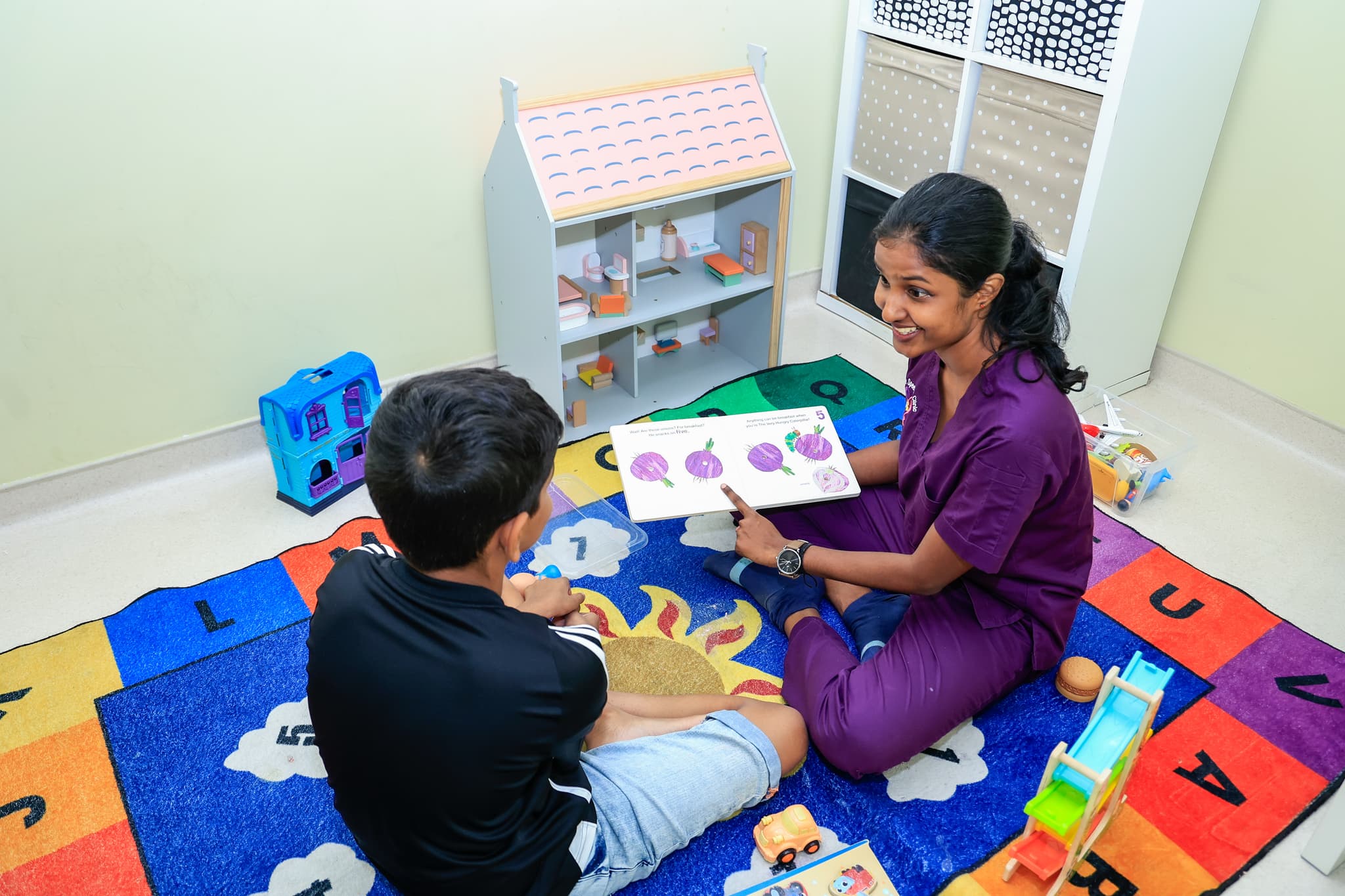
What parents often notice
- •Speech that sounds like lines from songs, cartoons, or familiar routines
- •Phrases that are long and melodic, while single-word requests are rare
- •Language that is hard to understand until you know the original context
- •A child who communicates richly in play but does not answer direct questions yet
How therapy is planned
The speech-language pathologist listens for whether the child is using whole gestalts, starting to mix pieces of them, or building new phrases. Goals match that stage. Early work often means acknowledging the child's phrases, modelling language they can pick up in play, and avoiding a demand to 'use your words' in a form they do not have yet.
This approach is common in autism support, and it is also used with other children whose language is developing in chunks. It is not a diagnosis by itself. A child can be a gestalt processor with or without an autism diagnosis. If you are comparing the two, see speech delay vs autism.
Where this sits with other services
Some gestalt processors also use AAC while speech is still hard to understand. Others need support for social communication in a group such as the Language Booster Club. Motor-speech difficulties, including apraxia, are a different problem and are assessed separately.
Sessions are for children through 16 years. Frequency is set after the first visits, not from a standard package.

Questions about gestalt language processing
No. It describes a way of developing language. Many autistic children are gestalt processors, and so are some children who are not autistic. Assessment looks at the language pattern, not only the diagnosis.
Those phrases are often real communication. Stopping them can remove the child's current way of talking. A therapist can show you how to respond to the phrase and offer language that is easier to mitigate into new sentences.
No. Analytic language development builds from single words to sentences. Gestalt development starts from larger chunks. Using the wrong starting point can make therapy feel unsuccessful even when the child is communicating.
Yes, when speech is not yet reliable for the child. AAC can carry the message while spoken language continues to develop. The speech-language pathologist decides this with you after assessment.
Related reading
Ask about a gestalt language assessment
If your child speaks in scripts, songs, or long phrases that are hard to unpack, an assessment can show the stage they are in and what to model at home.
Prefer to call? +971-508857146. You can also send a message from the form on this page, which opens WhatsApp.