Articulation Therapy for Children in Dubai
What is articulation therapy?
Articulation therapy helps a child learn to produce specific speech sounds more clearly, then use those sounds in words, sentences, and everyday conversation. It is one way speech-language pathologists support speech-sound difficulties.
Some children mislearn a sound, such as a lisp on “s”. Others use patterns that simplify whole groups of sounds. Assessment separates those patterns from language delay, hearing difficulty, and motor-speech disorders such as childhood apraxia of speech.
Updated 29 September 2026. Educational information from The Speech Clinic Dubai. It describes common concerns and what an assessment may involve. It is not a diagnosis and does not replace an individual assessment.
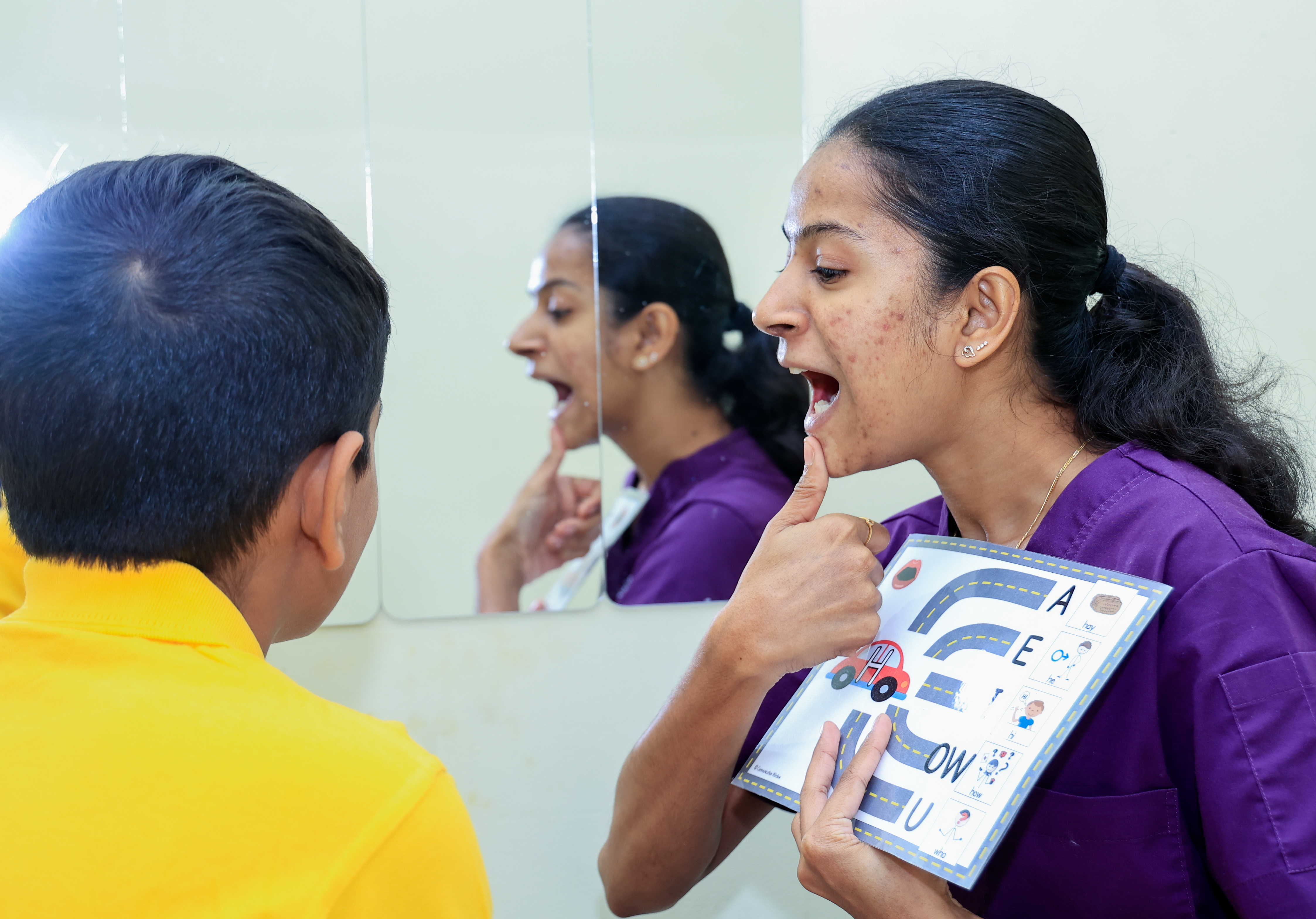
Speech sounds and speech-sound patterns
Articulation usually refers to how a particular sound is made with the lips, tongue, jaw, and voice. A phonological pattern is a rule the child is applying, such as leaving off the ends of words or replacing a whole group of sounds.
Both can make a child hard to understand. They are not treated in exactly the same way, so the first step is to find out which sounds are affected and whether a pattern is involved. If listeners struggle to follow your child, the page on speech that is difficult to understand describes that concern from a parent's point of view.
Who this may be relevant for
- •Children whose speech is less clear than expected for their age
- •Children who use a consistent sound substitution, omission, or distortion
- •Children whose unclear speech is affecting play, confidence, or preschool participation
- •Families who have been told to “wait and see” and want a clearer opinion
What assessment may involve
The therapist listens to single sounds, words, and connected speech, and compares that with what is typical for the child's age. Hearing history matters, because reduced hearing can change how sounds are learned.
The visit also checks whether the difficulty is mainly speech sounds, language, fluency, or motor planning. You should receive an explanation of which sounds or patterns were noted and whether therapy, review, or a different service is the better next step.
What therapy may involve
Therapy often starts by helping the child hear and produce the target sound, then practise it in syllables, words, phrases, and conversation. Home practice is usually short and specific.
If the child is using a phonological pattern, sessions may work on the pattern rather than one sound at a time. If motor planning is the main issue, articulation drills alone are not the right plan — see PROMPT therapy and childhood apraxia of speech.
What parents can expect
Clarity often changes gradually as a sound becomes automatic. The therapist should tell you what to practise and what not to correct, so home time does not turn into constant prompting.
Some speech-sound errors are common at certain ages and do not need therapy yet. Assessment is how that judgement is made for your child, rather than from a general chart alone.


Questions about articulation and speech sounds
Not always. Some sound errors are common while speech is developing. A speech-language pathologist considers the child's age, how understandable they are, and whether the error is changing before recommending therapy.
Some children do become clearer without therapy. Others keep a pattern that makes them hard to understand. An assessment is the practical way to tell which situation you are in.
No. Articulation therapy targets how sounds are produced. Language therapy targets understanding and using words and sentences. A child can need one, the other, or both.
Articulation therapy teaches a sound the child can usually plan once they know the placement. Childhood apraxia of speech is a difficulty planning and sequencing speech movements. The assessment looks for that difference so the wrong type of practice is not used.
Related reading
Book a speech-sound assessment
If your child is hard to understand, an assessment can show whether articulation therapy, a different approach, or monitoring is appropriate.
Prefer to call? +971-508857146. You can also send a message from the form on this page, which opens WhatsApp.