
Is there an autism test for kids?
There is no blood test, scan or single quiz for autism. Trained professionals identify it by looking at a child's developmental history and behaviour, usually after a screening questionnaire.
The CDC describes autism diagnosis as a process with several steps. It starts with everyday developmental monitoring by parents and doctors, moves to a short screening tool when a closer look is needed, and ends with a formal evaluation by specialists. When parents search for an “autism test”, they are usually looking for one of these steps, and each one answers a different question.
Noticing and milestone checks
Parents, carers, teachers, your child's doctor
Watching how your child plays, talks and moves, and raising what you notice at check-ups.
A validated screener
Your child's doctor or another professional
A short questionnaire, such as the M-CHAT-R/F for toddlers, that shows whether a closer look is needed.
A therapy assessment
Support can start hereSpeech-language pathologist, occupational therapist
Describes your child's communication, play, sensory and daily-living skills, and can start support.
A diagnostic evaluation
Developmental pediatrician, child psychologist or psychiatrist, often with a team
Combines developmental history, observation tools such as the ADOS-2, and other assessments.
Steps can overlap. A therapy assessment does not need to wait for a diagnosis.
What can an online autism test tell you, and what can it not?
An online test can help you put your worries into words, but it cannot rule autism in or out, especially for a young child.
Check who a quiz was written for. Some popular online autism tests are written for adults answering about themselves, so the questions may not fit a toddler or a child who is not yet talking. A score from a website also has no one behind it to ask follow-up questions, notice what the quiz missed, or explain what to do next.
Online quiz
- Quick and private
- Often not written for young children
- Cannot rule autism in or out
Validated screener
- Researched for a set age range
- Used with a professional
- Shows if a closer look is needed
Diagnostic evaluation
- Led by trained specialists
- History, observation and testing
- Can confirm or rule out autism
Your own notes are often more useful than a quiz score. Write down what you see, when it happens and what helps, and bring short videos from home. Our guide to speech delay vs autism explains why late talking on its own does not answer the question.
What is the M-CHAT, and when is it used?
The M-CHAT-R/F is a two-stage parent questionnaire that the American Academy of Pediatrics recommends for autism screening in toddlers up to 30 months.
Parents answer the first set of questions, and if the result suggests a closer look, a professional asks follow-up questions about the items that were flagged. The AAP recommends autism-specific screening at the 18 and 24 month check-ups, alongside general developmental screening at 9, 18 and 30 months.
9 months
Developmental screening
18 months
Developmental and autism screening
24 months
Autism screening
30 months
Developmental screening
Source: CDC summary of American Academy of Pediatrics recommendations. Screening can happen at any age if there is a concern.
Screeners are a starting point, not a final word. In a Swedish study from Karolinska Institutet published in JAMA Network Open in March 2026, researchers followed 2,178 children born very early or with complications. The M-CHAT was good at ruling autism out, but it flagged only about 6 in 10 of the children who were later diagnosed. The researchers also noted that language background and other developmental differences, such as motor or sensory difficulties, can affect how results are read. If your instinct says something is different, keep asking, even after a reassuring score.
What is the ADOS autism assessment?
The ADOS-2 is a structured, play-based observation that a trained clinician uses as one part of an autism evaluation, for ages from 12 months to adulthood.
During the ADOS-2, the clinician sets up activities and conversations that create natural chances to communicate, share attention and play, and notes how your child responds. Its publisher lists 40 to 60 minutes for the observation. It is not a test a child can pass or fail, and it is not used on its own: a diagnosis combines it with your child's developmental history, a parent interview and, often, language and cognitive assessments.
Children usually do best when they are rested and know what to expect. Tell your child the visit is about playing with a new grown-up, and bring a comfort item or snack if that helps.
What should you do after an autism screening result?
Write down what you have noticed, share it with your child's doctor, and ask for the next step rather than repeating online tests.
Use the guide below to see where to start. It does not give a diagnosis. It turns what you have noticed into a short list of next steps and notes to bring to an appointment.
After the test: next-step guide
What this can mean
Most online quizzes are not validated for young children, so the score cannot rule autism in or out. What you noticed while answering is still worth sharing.
At this age: This is the age range the M-CHAT-R/F is designed for. If it has not been done, ask your child's doctor to go through it with you, including the follow-up questions.
Where to start at The Speech Clinic
- Speech and language therapy for talking and understanding
These are worth discussing with a therapist at a first assessment. The therapist will say if another discipline should join.
A diagnosis, if one is needed, comes from a developmental pediatrician, child psychologist or psychiatrist. Ask your child's doctor about a referral. Therapy can start while you wait.
Notes to bring to your appointment
- Which test or screener was used, when, and a copy of the result if you have one.
- Write down the words, sounds or gestures your child uses, and what they seem to understand.
- Two or three short phone videos of your child at home, playing and talking.
This guide is general information. It does not screen for or diagnose autism.
Waiting times matter to families everywhere. In Abu Dhabi, for example, the Department of Health designated eight autism diagnostic centres in April 2026 and requires them to offer an initial assessment within 14 days of a referral or booking. In Dubai, ask your child's pediatrician for a referral to a developmental pediatrician or a multidisciplinary team, and start therapy support while you wait if your child needs it.
Can therapy start before an autism diagnosis?
Yes. At The Speech Clinic you do not need a completed autism assessment to ask for a speech, occupational therapy or feeding assessment.
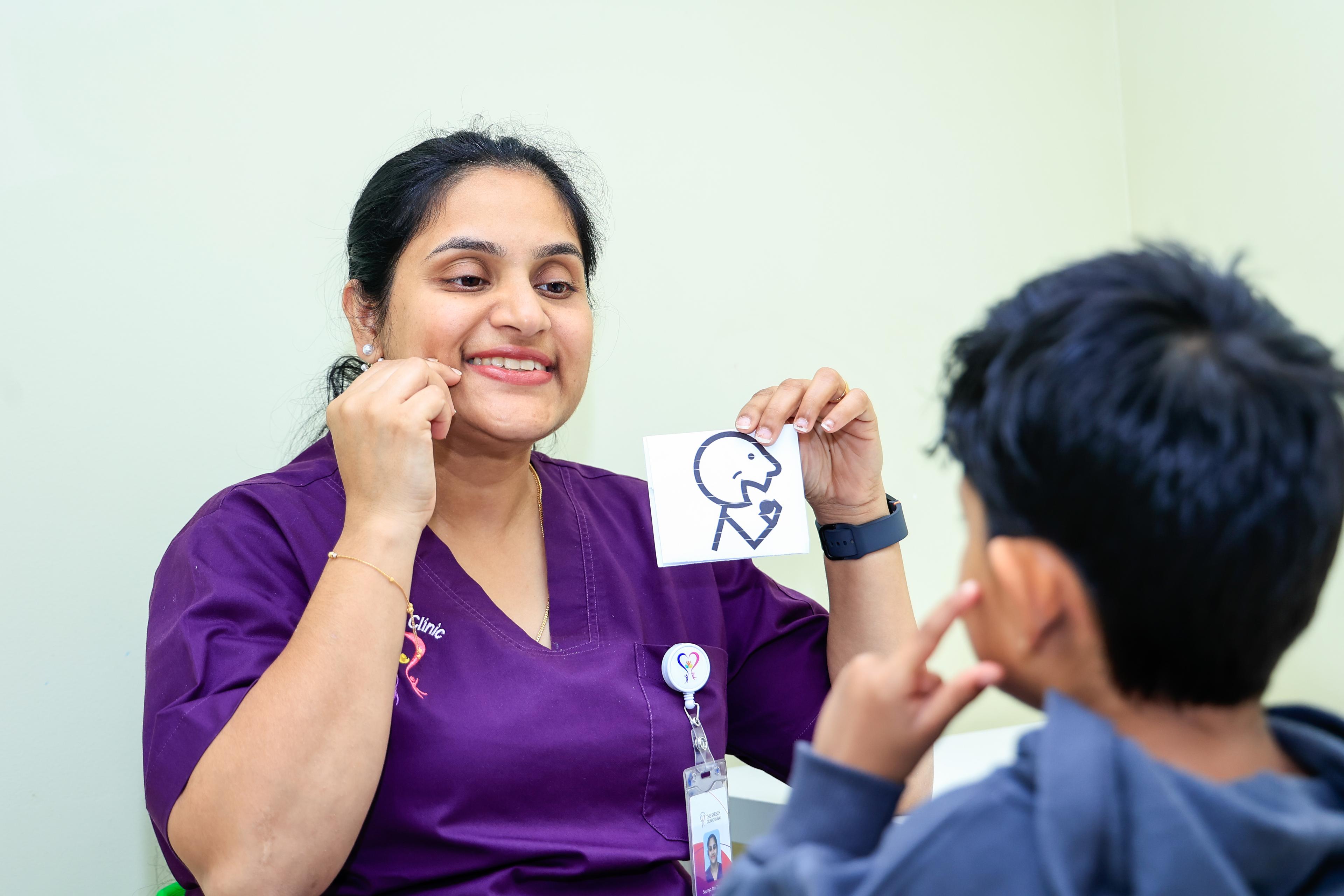
A speech-language pathologist describes how your child communicates today: understanding, words, gestures, play and social connection. That is useful whatever the eventual answer, and it gives the diagnostic team clear information to work with. An autism diagnosis is a separate clinical decision.
Our speech and language therapy team in Dubai Healthcare City sees children from early childhood through 16 years, in English and Arabic. If speech is not yet a reliable way to communicate, AAC can be considered early. Read more about autism early intervention in Dubai and which service to start with.
School-age child, new questions?
Some children are first noticed at school, when conversations, friendships and classroom routines get more complex. Ask the teacher for written examples, and bring them to your child's assessment. Our article on autism and apraxia of speech shows why a full evaluation looks at more than one thing.